
Introduction
For several years I have taken courses online through thegreatcourses.com and also on their app. The Great Courses provides access to highly acclaimed teachers on video. The current course that I am attending is named, Turning Points in Modern History. Some of the topics are the Fall of Constantinople, Discovery of the New World and the Invention of the Printing Press.
Main
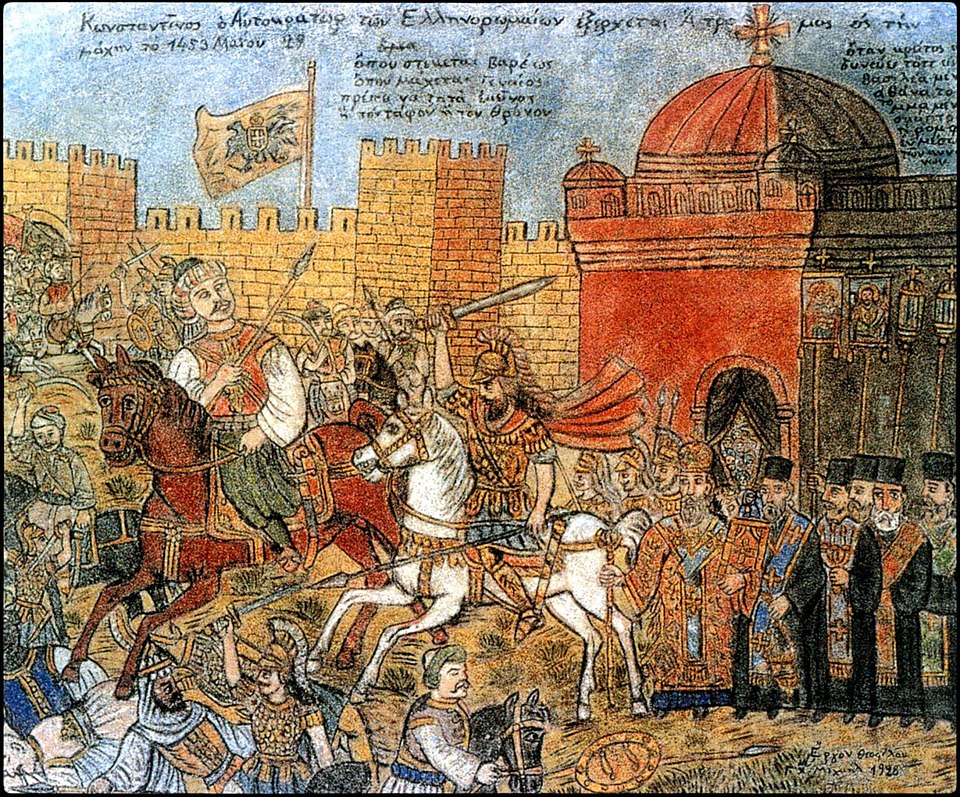
The Fall of Constantinople in 1453 stands as one of the most significant turning points in world history. It marks the end of the Byzantine Empire and the rise of Ottoman dominance. The event reshaped political power, altered trade routes, and contributed to major cultural and intellectual transformations.
Its importance extends far beyond the immediate military victory, influencing the development of Europe, the Middle East, and the wider world in profound ways.
First and foremost, the fall signaled the definitive end of the Byzantine Empire, which had been a continuation of the Eastern Roman Empire for over a thousand years. Constantinople had long served as a center of Christian civilization, preserving Roman law, Greek learning, and Christian theology throughout the Middle Ages.
Its capture by the Ottoman Turks under Sultan Mehmed II brought an abrupt end to this legacy as an independent political entity. This marked not only the collapse of a state but also the disappearance of a major Christian stronghold in the eastern Mediterranean.
The Fall of Constantinople thus marked a shift in the balance of power from a declining Byzantine state to a rising Islamic empire. That is, after the fall of Rome in around 400 AD, Constantinople served as the second Rome. It was also a catalyst for Ottoman desire to conquer Europe. At its height, the Ottomans got to the gates of Vienna.
Another crucial consequence of the fall was its impact on trade. Constantinople had been a vital hub for commerce between Europe and Asia, particularly along routes that brought spices, silk, and other luxury goods from the East to European markets. After 1453, the Ottomans gained control over many of these trade routes, which made access more difficult and expensive for European merchants. This disruption encouraged European nations to seek alternative routes to Asia, ultimately contributing to the Age of Exploration.
Explorers such as Christopher Columbus and Vasco da Gama were motivated, in part, by the desire to bypass Ottoman-controlled lands and establish direct trade connections with Asia. Columbus courted European leaders for some 20 years before he convinced King Ferdinand and Queen Isabella to finance his exploration of a “new route to India.”
The Fall of Constantinople also played a key role in the spread of knowledge and the development of the Renaissance. As the city came under Ottoman control, many Greek scholars fled to Western Europe, particularly to Italy. They brought with them valuable manuscripts of ancient Greek and Roman texts that had been preserved in Byzantine libraries. These works helped to revive classical learning and inspired new developments in art, science, and philosophy. The transmission of this knowledge contributed significantly to the intellectual awakening that characterized the Renaissance.
Militarily, the fall demonstrated the increasing importance of new technologies, especially gunpowder and artillery. The Ottomans’ use of massive cannons to breach the formidable walls of Constantinople showed that even the strongest medieval fortifications could be overcome. This marked a shift in warfare, as traditional defensive structures became less effective against modern weaponry. As a result, military strategies and the design of cities and fortifications began to change across Europe and beyond. For example, without canons, the Ottomans could not have breached Constantinople’s walls.
Religiously, the Fall of Constantinople had a deep psychological impact on Christian Europe. It heightened tensions between Christian and Muslim states and reinforced fears of further Ottoman expansion into Europe. At the same time, it widened the divide between the Eastern Orthodox and Roman Catholic worlds, as earlier efforts to unify the churches had failed to prevent the city’s isolation.
The cultural transformation of Constantinople itself is another important aspect of its significance. Under Ottoman rule, the city became a center of Islamic culture, administration, and architecture. Churches such as Hagia Sophia were converted into mosques, symbolizing the shift in religious and political authority. Over time, Istanbul grew into a vibrant, multicultural capital that blended elements of Byzantine, Islamic, and later European influences.
Finally, the Fall of Constantinople is often considered a symbolic marker of the end of the Middle Ages and the beginning of the early modern period. While historians debate exact dates, 1453 represents a moment when old structures gave way to new realities. The decline of feudalism, the rise of centralized states, advancements in technology, and the expansion of global exploration all gained momentum in the years following the fall.
Conclusion
In conclusion, the Fall of Constantinople in 1453 was far more than a military conquest. It ended the Byzantine Empire, elevated the Ottoman Empire to global prominence, disrupted traditional trade networks, and helped spark the Renaissance and the Age of Exploration. Its impact was felt across continents and centuries, making it one of the most important events in world history. By reshaping political power, economic systems, and cultural exchanges, the Fall of Constantinople fundamentally altered the course of human development and set the stage for the modern world.
