
Introduction
Today, I participated in a weekly telephone conference with colleagues. Our discussion focused on the enormous power of the Executive Branch of our government at the expense of Congress.
These developments are troubling because many of the initiatives of the Trump Administration are unpopular with most Americans. While I am in a minority, I favor militarily trying to get regime change in Iran. That said, I am fully aware of Abraham Lincoln’s warning “that with public sentiment nothing can fail, without it, nothing can succeed.”
In brief, America is on the precipice of a major war that could go in two very different directions. On the one hand, we could eliminate a major source of terrorism in the Mideast region and extend the Abraham Accords to many Gulf States. On the other hand, Iran could prevail. Their government could rebuff any moderation in their policies, including developing a nuclear capability with attendant missile support.
Sadly, President Trump has alienated so many Americans that he has handicapped his ability to pursue his military objectives in Iran. At this point, failure means that many of our allies in the Gulf have suffered enormous physical damage without recompense.
Main
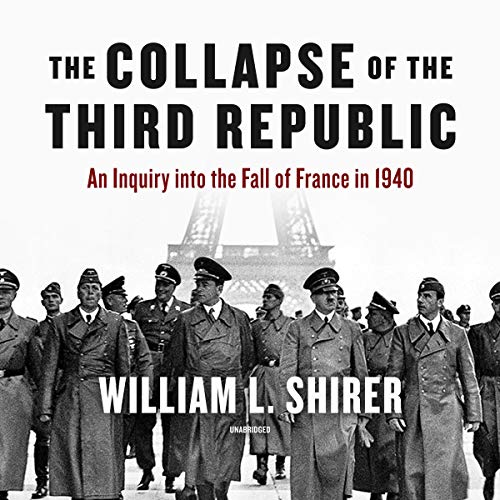
In The Collapse of the Third Republic, William L. Shirer presents a detailed and often critical account of how France, one of Europe’s great powers, fell so rapidly to Nazi Germany in 1940. Drawing on his experience as a correspondent in Europe and on extensive documentary evidence, Shirer argued that France’s defeat was not simply the result of German military strength, but rather the culmination of deep political, social, and military weaknesses within the French Third Republic.
I would argue that America today has similar weaknesses. We are deeply divided politically and socially. While I will not admit that militarily we are divided, I would argue that the number of troops that we have available to fight against Iran is far smaller than the 450,000 we deployed in 1990-1991 to roll back Iraqi forces that had invaded Kuwait. In that war, we enjoyed the support of 35 nations that supplied 200,000 forces, bringing the total size of the allied troops to 750,000. The assembling of such a massive force took four months. By contrast, the Trump Administration is forecasting ending the war in weeks. With the exception of Israel, no other country has committed troops to our cause.
Shirer’s central thesis was that the collapse of France was fundamentally a failure of leadership. He contended that the political class of the Third Republic was fragmented, indecisive, and unable to respond effectively to the mounting threat posed by Adolf Hitler and Nazi Germany. Frequent changes in government, weak coalitions, and partisan divisions created an atmosphere in which long-term strategic planning was nearly impossible. Shirer emphasized that this instability eroded public confidence and undermined the state’s ability to act decisively in moments of crisis
Today, America lacks respected leadership. Neither President Trump nor Secretary of Defense Pete Hegseth are highly regarded by a majority of Americans.
A key theme in Shirer’s analysis was the role of appeasement. Like many contemporaries, French leaders hoped to avoid another devastating war like World War I. As a result, they often pursued policies aimed at accommodating German demands, particularly during the 1930s. Shirer criticized this approach as dangerously naïve, arguing that it emboldened Hitler rather than restraining him. He places significant responsibility on French leaders who, in his view, underestimated both Hitler’s ambitions and the urgency of rearmament.
America has appeased the Iranian regime since 1979, even when Iran called for Destruction of the Great Satan. We have negotiated with them over the years without any meaningful change in their behavior. Iran has supported terrorist organizations for years in Yemen, Syria, Lebanon, Iraq and Gaza.
Another important factor in Shirer’s account was the social and psychological condition of France in the interwar years. He argued that the trauma of World War I left the French population deeply fearful of another conflict. This widespread desire for peace, while understandable, contributed to a lack of national resolve when confronted with the growing threat of Nazi aggression. Shirer suggested that divisions within French society—between left and right, workers and elites—further weakened the country’s ability to unite in defense of the republic.
In our case, America has participated in three failed wars—Vietnam, Afghanistan, and Iraq. We have totally failed to create meaningful, longstanding regime change.
The book examined the role of individuals during the crisis of 1940. Shirer contrasts figures who advocated continued resistance with those who supported surrender and collaboration. He was particularly critical of leaders who quickly accepted defeat and helped establish the Vichy regime, viewing their actions as a betrayal of republican values. At the same time, he acknowledges that a handful of leaders recognized the gravity of the situation and sought to continue the fight, even as circumstances deteriorated rapidly. The most famous dissonant was Charles DeGaule.
Conclusion
In my opinion, The Collapse of the Third Republic, remains an important and influential work. It offers a compelling explanation of how a major European power could fall so quickly and highlights the dangers of political division, complacency, and failure of leadership. Shirer’s analysis serves as both a historical account and a cautionary tale about the consequences of ignoring emerging threats.
I worry that America will not only fail against Iran, but also lose its leadership position to China, a much more potent advocate than the Soviet Union. Unlike the Soviet Union which was an economic lightweight, China currently has the world’s second largest GNP. Their industrial capacity surpasses ours. To the extent that Asia, not Europe becomes the world’s most important region, China will be a formidable competitor.
