

Over the past 20 years, Pew Research has conducted surveys of Americans observance of religion.
After many years of steady decline, the share of Americans who identify as Christian shows signs of leveling off – at least temporarily – at slightly above six-in-ten, according to a massive new Pew Research Center survey of 36,908 U.S. adults.
That said, there is a dramatic falling off religiosity by young people. For example, in the age group of 18–24-year-olds:
- Identify as Christian (46% vs. 80%)
- Pray daily (27% vs. 58%)
- Say they attend religious services at least monthly (25% vs. 49%)
Although Muslims represent only 1.2% of the U.S. population, the number of Muslims is up from .4% in 2007.
The charts below show some fascinating statistics on how religion and spirituality have changed between 2007 and 2023-24.
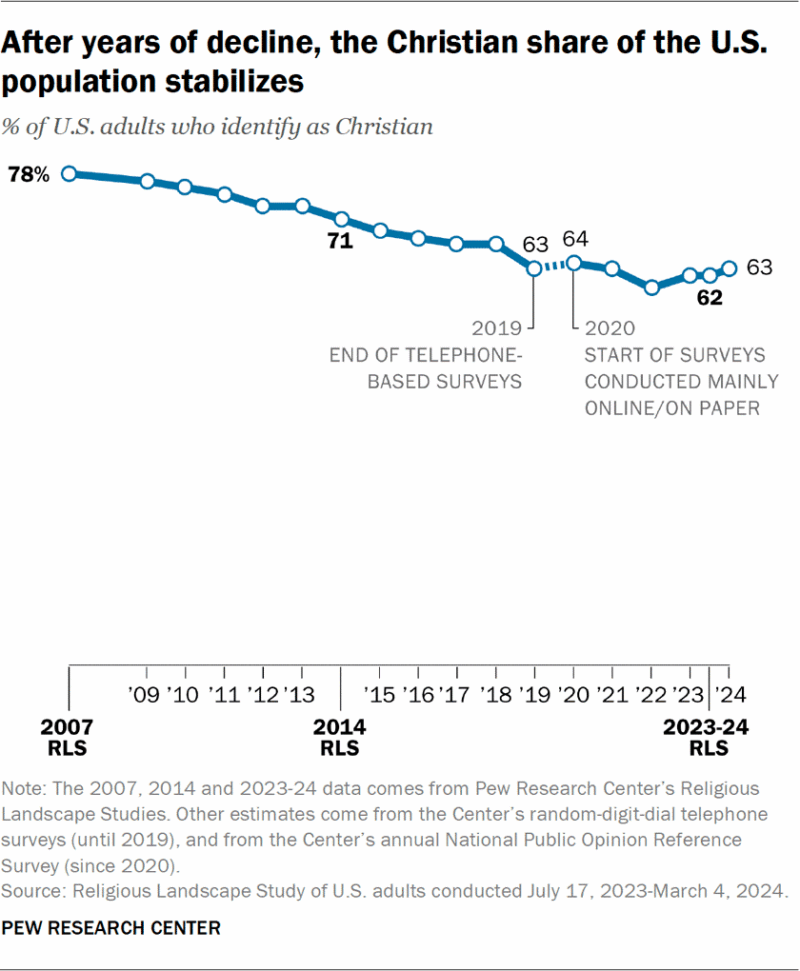
The latest RLS, fielded over seven months in 2023-24, finds that 62% of U.S. adults identify as Christians. That is a decline of 9 percentage points since 2014 and a 16-point drop since 2007.
But for the last five years, between 2019 and 2024, the Christian share of the adult population has been relatively stable, hovering between 60% and 64%. The 62% figure in the new Religious Landscape Study is smack in the middle of that recent range.
The largest subgroups of Christians in the United States are Protestants – now 40% of U.S. adults – and Catholics, now 19%. People who identify with all other Christian groups (including the Greek and Russian Orthodox Churches, the Church of Jesus Christ of Latter-day Saints, Jehovah’s Witnesses and many others) total about 3% of U.S. adults.
Meanwhile, the share of Americans who identify with a religion other than Christianity has been trending upward, though it is still in single digits.
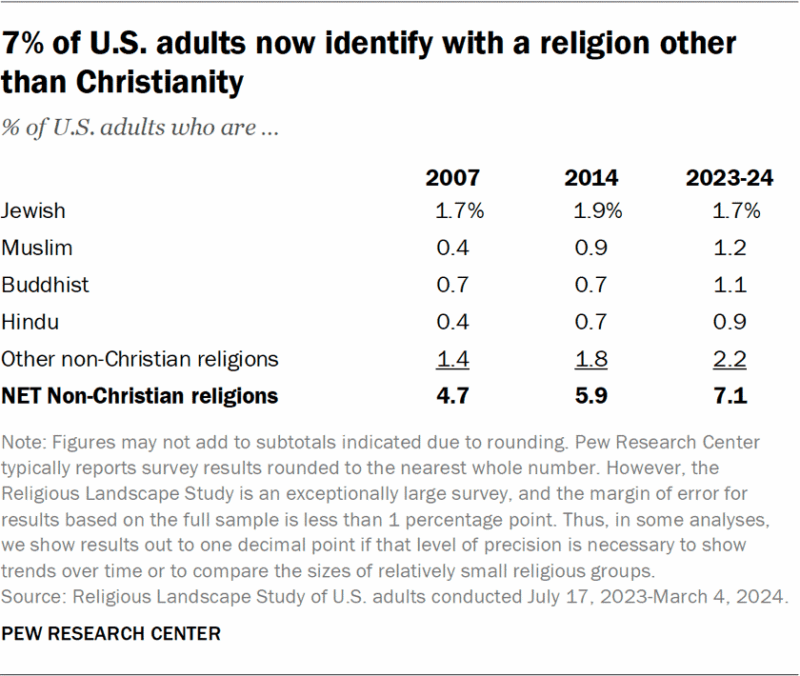
Today, 1.7% of U.S. adults say they are Jewish when asked about their religion, while 1.2% of respondents in the new survey are Muslim, 1.1% are Buddhist, and 0.9% are Hindu.
Religiously unaffiliated adults – those who identify as atheists, agnostics or as “nothing in particular” when asked about their religion – account for 29% of the population in the new RLS. The size of the religiously unaffiliated population, which we sometimes call religious “nones,” has plateaued in recent years after a long period of sustained growth.
Rates of prayer, attendance at religious services also relatively stable
Other standard survey measures contribute to this emerging picture of stability:
- Though down significantly since 2007, the share of Americans who say they pray daily has consistently held between 44% and 46% since 2021.
- Similarly, since 2020, the percentage of U.S. adults who say they attend religious services monthly has hovered in the low 30s. Spiritual beliefs are widespread.
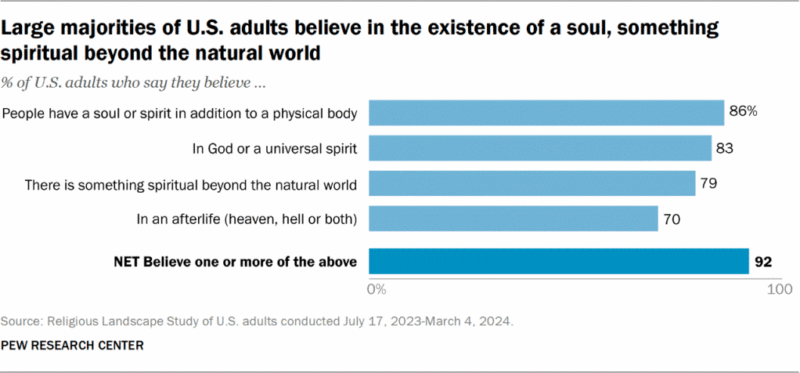
Pew research showed that large majorities of Americans have a spiritual or supernatural outlook.
For example:
- 86% believe people have a soul or spirit in addition to their physical body.
- 83% believe in God or a universal spirit.
- 79% believe there is something spiritual beyond the natural world, even if we can’t see it.
- 70% believe in an afterlife (heaven, hell or both).
But, despite these signs of recent stabilization and abiding spirituality, other indicators suggest we may see further declines in the American religious landscape in future years.
Namely, younger Americans remain far less religious than older adults.
For example, the youngest adults in the survey (ages 18 to 24) are less likely than today’s oldest adults (ages 74 and older) to:
- Identify as Christian (46% vs. 80%)
- Pray daily (27% vs. 58%)
- Say they attend religious services at least monthly (25% vs. 49%)
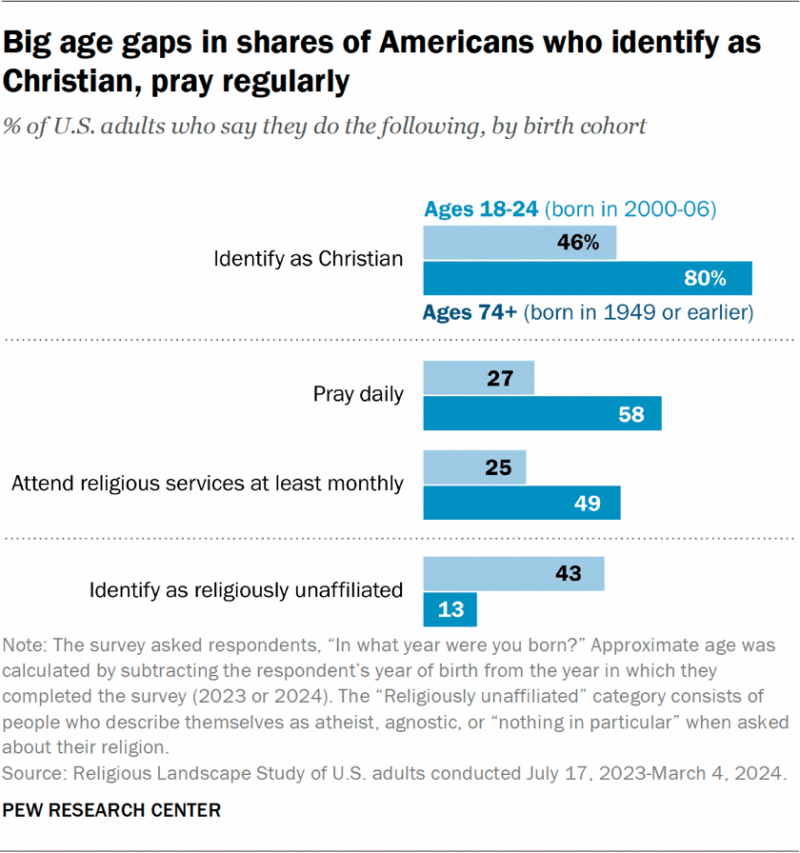
And the youngest adults are more likely than the oldest Americans to be religiously unaffiliated (43% vs. 13%).
Also, younger Americans are less likely than older adults to say they were raised in religious households.1 And, compared with older adults, fewer young people who were raised in religious households have remained religious after reaching adulthood.
