
Personal Background:
I majored in Economics at the University of Texas earning a BA and then master’s degrees in Economics and an MBA from the University of Michigan.
My career on Wall Street spanned 40 years rising to a partner in Morgan Stanley when it was a private firm. Writing about finance, economics, history and social issues is a passion of mine which I did for the Sarasota Herald Tribune for over 10 years.
Let’s talk about the history of tariffs, Trump’s tariff policies and why gold was important.
I’ll begin with – Why gold was important
Historically, when countries were on the gold standard the goal was a tariff surplus. The payments to countries were in gold which meant the countries ongoing surpluses created a strong economy. By contrast, countries having ongoing deficits could no longer import needed goods.
Why, from a monetary perspective, has gold lost its key role? (“From a women’s perspective, gold remains very important.”)
The elimination of gold as the backing of currency changed its central role in finance. The United States has a unique history. From post-civil war until WorId War I, the United States suffered ongoing trade deficits. Then, from World War I until the Nixon Administration, we enjoyed large surpluses.
In 1972, Nixon took us off the gold standard. After the Nixon Administration, we have experienced trade deficits. He told foreign countries they must accept dollars as repayment for our deficits.
The recipients of U.S. dollars were satisfied because the dollar was the world’s number one reserve currency and was accepted at face value. The quid pro quo was that the dollar was strong relative to other currencies.
The consequence for using the dollar is that if foreigners ever lose confidence in the U.S. dollar, our economic outlook will be uncertain. They may not so readily accept dollars for payments of their exports to us.
History about Tariffs
In both my academic and financial career, trade deficits were never considered a problem! The U.S. received a countries goods and those countries were able to build up a strong manufacturing base.
Economically, the whole world benefitted from an era of low tariffs. International trade allowed the best products to be produced in the most appropriate countries and were acquired at the lowest price by appreciative buyers (countries). Tom Friedman, in his famous book titled, The World Was Flat, describes the world with low tariffs.
The Great Downside of Tariffs
I was taught both in undergraduate and graduate studies of the great downside of tariffs.
In 1930, the United States passed The Smoot–Hawley Tariff Act. Following the passing of this bill, most economists believed that it was an economic disaster.
Why was Smoot-Hawley an economic disaster?
- The law sharply raised U.S. tariffs on more than 20,000 imported goods at the onset of the Great Depression.
- Its intent was to protect American farmers and manufacturers, but the repercussions from this bill was the opposite.
- Trading partners retaliated almost immediately, imposing their own tariffs on U.S. exports. Global trade collapsed: between 1929 and 1934, world trade fell by roughly two-thirds.
Rather than cushioning the economy, Smoot–Hawley deepened and prolonged the Great Depression by:
- Crippling U.S. export industries
- Raising consumer prices during a deflationary crisis
- Reducing business confidence and investment – companies could not sell their goods abroad
- Intensifying international economic nationalism
To offset the negative impact of tariffs, the U.S. government needed to provide financial aid to farmers and businesses. Sadly, the US government, feeling that a balanced budget was paramount, did not understand the need to provide subsidies to farmers and businesses to encourage them to (1) buy equipment and (2) hire workers.
Donald Trump’s Views on Tariffs
Trump’s views on tariffs vary sharply from the prevailing economic theories I learned.
As a presidential candidate, President Trump advocated for high tariffs for the following reasons:
1) The tariffs were aimed primarily at China, now a cold war adversary with whom we have multi-billion-dollar trade deficits, and
2) He argued that tariffs would increase U.S. GNP by $750 billion.
Currently, the Federal Reserve worries that we could be on the eve of a recession. The Fed’s current dilemma – do we lower interest rates to stimulate business spending or do we keep rates high to fight inflation?
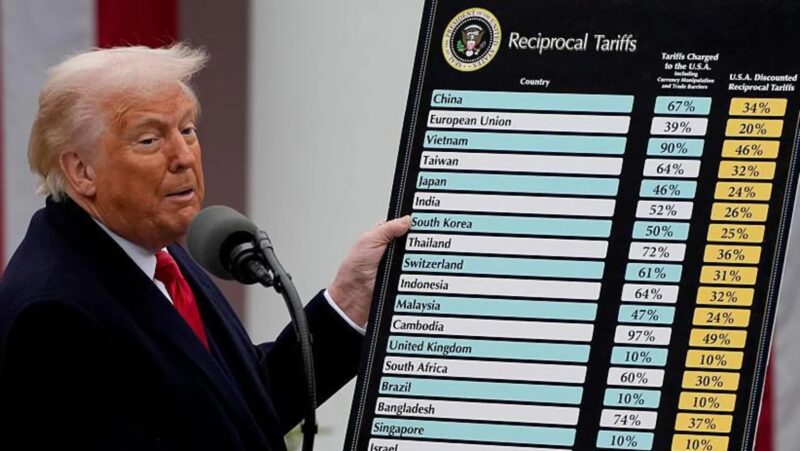
As president, Trump has used tariffs as bargaining tools to get concessions from our trading partners. He believes that tariffs reduce the overall U.S. trade deficit, possibly to zero. Trump thinks that imposing tariffs will protect and possibly build up American manufacturing in the following areas: U.S. steel, aluminum, and the automobile industries. The growth of those industries, if it happened, will increase our GNP substantially.
Economists counter that these historic industries are not our future because our wages are not competitive, especially with countries such as China, Vietnam, South Korea, etc.
Trump has pressured our trading partners to change negative practices against the U.S., such as, intellectual property theft and other barriers to accepting U.S. exports to their countries. Most economists agree that Trump is correct on taking these measures which will: 1) Strengthen national security for key industries and, 2) The income from tariffs would reduce U.S. Budget Deficits. Trump said it would add possibly $trillions in new revenue.
Trump’s opponents contend or countered with the following:
1) Trade deficits in of themselves are not bad. That is, as long as exporters accepted U.S. dollar as payment.
2) Americans benefitted from goods at lower prices than U.S. manufacturing could deliver.
3) Tariffs will add to inflation above our current 3% level. The historic goal is 2% inflation. Remember, inflation is a tax on the consumer!
4) Tariffs would result in higher input costs for U.S. manufacturers using imported materials.
An example: Automobile manufacturers are close to the border with Mexico. Their products go back and forth between U.S. and Mexico multiple times a day. Havoc will ensue if every time we get a good from Mexico, a new tariff is added.
Economists believe that China, EU and other countries would impose retaliatory measures and foreign countries imposing tariffs will harm U.S. exports, like soybeans and pork. To counter lost revenue, Trump proposed providing direct payments to farmers. The Trump policies simultaneous hurt the American consumer who are paying more for imported goods and require subsidizing the farmers!
What have Trump’s Tariffs accomplished to date?
1) Tariffs will bring in a projected $300 billion annually to government revenues. Not nearly enough to offset our staggering deficit.
2) Trump wrongly assumed that companies would not pass on higher costs. The reality is that most costs must be passed on.
3) Tariffs have contributed to inflation and therefore, been a tax on the American consumer.
4) Tariffs have created great uncertainty. From day-to-day Trump imposes very high tariffs and then reduces them when he achieves some of his political gains. For example, he raised tariffs to 100% on an erstwhile ally India and then reduced them to 50%. This back and forth has caused havoc.
5) Trump has alienated former strong allies such as Canada, Great Britain, and the European Union.
6) Trump’s on and off tariff announcements have increased volatility in the stock market.
7) Trump said that 10% global trade tariffs on all countries would add 2.8 million jobs. Economists said that tariffs would cost jobs. After 8 months in office unemployment is at 4.4% — a 4 year high.
The long-term impact of tariffs is hard to calculate. They might lead to more U.S. domestic manufacturing. There are many people who are skeptical for the following reasons:
- Our labor costs are much higher that China, South Korea, Vietnam, etc.
- Why would a company spend $ billions on building a plant when either Trump or the next administration reverses the Trump tariff policies.
- Added costs to certain companies have made their products not as competitive.
Time will tell if Trump’s tariffs accomplish his goals.
