
Introduction
I recently read Road to Surrender by Evan Thomas that describes the atmosphere leading to the Japanese surrender ending World War II. There were several key issues that led to that decision. Many historians conclude that the officers who resisted surrender were not necessarily irrational. They had spent years fighting a total war and had been taught that surrender was worse than death. Other key issues were the atomic bombings, Soviet declaration of war, destruction of Japanese cities, and the collapse of supplies that convinced most leaders that continuing the war would only bring greater devastation to Japan.
Fortunately, cooler heads prevailed. By August 1945 Japan’s military position was hopeless.
One of the surprising things was in Japan, dissembling is totally acceptable which is saying one thing but meaning and doing another thing. Thus, Japanese diplomats who wanted peace were afraid to state their opinion fearing assassination. Somehow, their listeners understood their true intentions.
Moderates in Japan mistakenly thought that reaching out to the Soviet Union in mid-1945 to mollify the “unconditional surrender terms” would be beneficial.
In hindsight, it was a major miscalculation.
Why Japan approached the Soviet Union?
In 1945, Japan knew it was losing the war. Some leaders wanted peace, but they hoped to avoid unconditional surrender and preserve:
- The position of Emperor Hirohito
- Some control over Japan’s future government
- Protection from occupation and war-crimes prosecutions
The Soviet Union and Japan were still formally at peace under the Japanese Soviet Neutrality Pact. Japanese leaders hoped that Joseph Stalin could act as a mediator between Japan and the Allies.
Why it was a miscalculation
The problem was that Stalin had already secretly agreed at the Yalta Conference to enter the war against Japan after Germany was defeated.
While Japanese diplomats were trying to secure Soviet mediation:
- The Soviets were preparing a massive invasion of Manchuria.
- Stalin had little incentive to help Japan.
- Soviet leaders expected to gain territory and influence by joining the war.
In effect, Japan was negotiating with a country that had already decided to become its enemy.
Main Topic
Timeline
- August 6, 1945 – The United States dropped the atomic bomb on Hiroshima.
- August 8, 1945 – The Soviet Union declared war on Japan, ending the Soviet-Japanese Neutrality Pact.
- August 9, 1945 – Soviet forces launched a huge offensive into Japanese-held Manchuria; later that day, the United States dropped the second atomic bomb on Nagasaki.
- August 15, 1945 – Emperor Hirohito announced on radio that the Japanese must “bear the unbearable!”
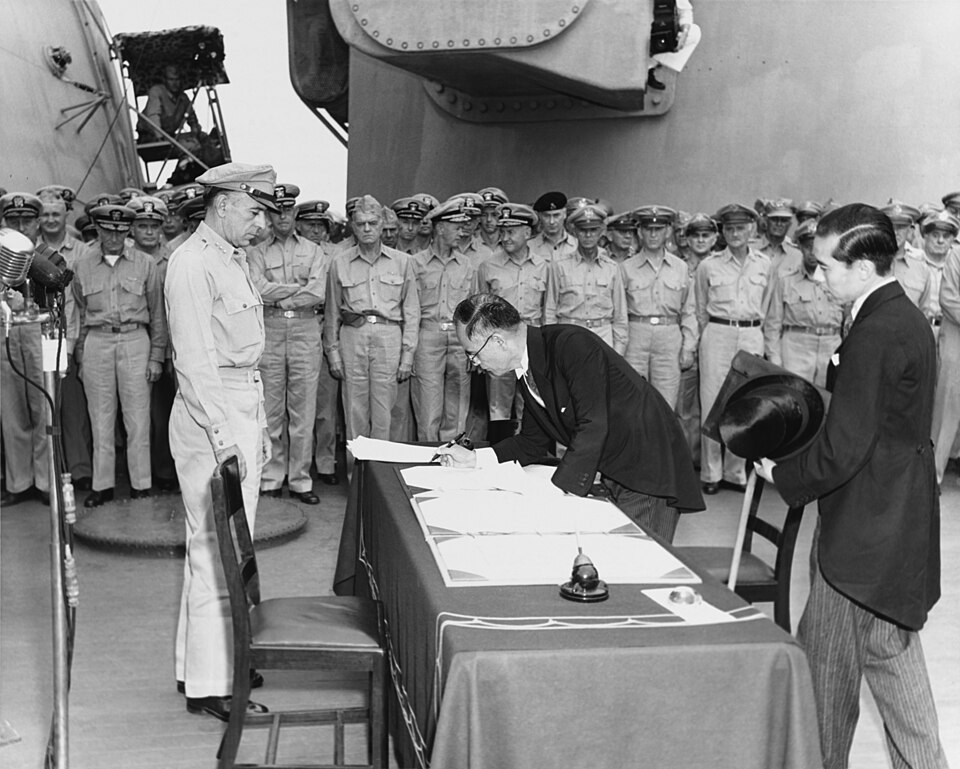
- September 2, 1945—Japanese government officials signed the surrender instrument aboard the battleship USS Missouri in Tokyo Bay. Aside from America, there were representatives from the Soviet Union, Great Britain, France, New Zealand, Australia, Philippines, etc.
The decision of Japan to surrender in August 1945 marked the end of World War II and remains one of the most debated events in modern history. After nearly four years of conflict in the Pacific and six years of global warfare, Japan’s leaders faced a series of military, political, and economic crises that made continued resistance increasingly difficult. The atomic bombings of Hiroshima and Nagasaki played a crucial role in Japan’s decision to surrender, but they were not the only factors. The Soviet Union’s declaration of war against Japan, the destruction of Japan’s cities through conventional bombing, and the deteriorating condition of the Japanese economy also contributed to the final decision. Understanding why Japan surrendered requires examining the combination of these factors and how they influenced Japanese leaders in the final days of the war.
The role of the Emperor Hirohito in the Japanese surrender is key. That is, until the last months of World War II, the Emperor was committed to ongoing combat. At some point, he recognized that the military promise “of one great battle that would turn the tide or at least provide Japan with some negotiating power was unrealistic.”
For Hirohito surrendering was personally very difficult. In Japan, he had the status of a deity. Hirohito recognized that his role going forward would be marginal at best. While the Americans might promise leniency, it was not a foregone conclusion. Many Americans viewed the emperor as the arch enemy who deserved capital punishment. Moreover, Japanese treatment of defeated foes—both military and civilian—was reprehensible. It was rational to expect retribution.
By the summer of 1945, Japan’s military situation had become desperate. The Japanese navy had been largely destroyed and Allied forces controlled much of the Pacific Ocean. American submarines disrupted Japanese shipping, causing severe shortages of food, fuel, and raw materials. Japanese cities were suffering from extensive bombing raids. In March 1945, the firebombing of Tokyo killed tens of thousands of civilians and devastated large portions of the city. Similar attacks were carried out against many other urban areas. Despite these losses, many members of Japan’s military leadership remained committed to fighting. They hoped that by inflicting heavy casualties on any invading Allied force, Japan could negotiate more favorable surrender terms.
American military and political leaders had several options to end the war; (1) a blockade of Japan causing mass starvation (2) invade Japan causing millions of deaths to Japanese civilians and soldiers as well as our soldiers (3) drop the atomic bomb (4) defeat the five million Japanese soldiers serving in China, Indonesia, French Indo China, etc., and (5) allow the Soviet Union, with which we already had a stressful relationship, to participate in the defeat of Japan.
On August 6, 1945, the United States dropped the world’s first atomic bomb used in warfare on the city of Hiroshima. The bomb instantly destroyed much of the city and killed tens of thousands of people. Many more would die later from burns, injuries, and radiation exposure. The scale of destruction was unlike anything previously seen in warfare. Entire neighborhoods vanished within moments, and the city ceased to function as an organized community. Despite the shocking nature of the attack, some Japanese leaders initially believed that the bombing alone did not require immediate surrender. Communication problems and uncertainty about the exact nature of the weapon delayed a full understanding of the event.
Three days later, on August 9, the United States dropped a second atomic bomb on Nagasaki. Again, immense destruction followed. The use of two atomic bombs within such a short period demonstrated that the United States possessed a powerful new weapon and was prepared to use it repeatedly. The bombings convinced many Japanese officials that their country faced the possibility of complete destruction if the war continued.
However, the atomic bombings were not the only major events occurring during this period. On August 8, 1945, between the two bombings, the Soviet Union declared war on Japan and launched a massive invasion of Japanese-held territory in Manchuria. This development was a severe blow to Japanese hopes. Some Japanese leaders had hoped that the Soviet Union, which had remained neutral toward Japan for much of the war, might help mediate peace negotiations with the Allies. The Soviet declaration of war eliminated that possibility. Moreover, the rapid Soviet advance demonstrated that Japan now faced a two-front conflict against overwhelming military forces.
Historians continue to debate which factor was more important: the atomic bombings or the Soviet entry into the war. Some argue that the atomic bombs were decisive because they introduced a new level of destruction and showed that Japan could not defend itself against future attacks. Others emphasize that it was the Soviet invasion, noting that it destroyed Japan’s diplomatic strategy and increased fears of occupation by both American and Soviet forces. Many scholars today conclude that both developments worked together to convince Japanese leaders that further resistance was hopeless.
A key figure in Japan’s surrender was Emperor Hirohito. Traditionally, the emperor had not played a direct role in military decision-making. However, in August 1945, disagreement among Japan’s leaders reached a critical point. Some military officials wanted to continue fighting despite the country’s deteriorating position. Others believed surrender was necessary to save Japan from complete ruin. The deadlock was eventually broken when Hirohito personally supported accepting the Allied terms outlined in the Potsdam Declaration.
The Potsdam Declaration, issued in July 1945 by the United States, Britain, and China, called for Japan’s unconditional surrender. It warned of “prompt and utter destruction” if Japan refused. After the atomic bombings and Soviet entry into the war, Japan’s leaders decided to accept the declaration, provided that the emperor could remain on the throne. The Allies ultimately allowed Hirohito to remain as a symbolic figurehead, although his political authority was greatly reduced.
On August 15, 1945, Hirohito addressed the Japanese people by radio, announcing Japan’s surrender. For many citizens, it was the first time they had ever heard the emperor’s voice. In his speech, Hirohito referred to the “new and most cruel bomb” and explained that continued fighting would lead to the destruction of the Japanese nation. The formal surrender ceremony took place aboard the USS Missouri on September 2, 1945, officially ending World War II.
Conclusion
The decision to surrender was one of the most significant turning points in modern history. It ended the deadliest conflict the world had ever experienced and began a new era shaped by nuclear weapons. The atomic bombings remain controversial, with ongoing debates about whether they were necessary and whether alternatives existed. Supporters of the bombings argue that they helped end the war quickly and avoided the massive casualties that might have resulted from an invasion of Japan. Critics contend that Japan was already close to defeat and that the bombings caused unnecessary civilian death and suffering.
After reading Road to Surrender, I support the decision to bomb both Hiroshima and Nagasaki.
