
Introduction
My friends know my ongoing interest in events surrounding World War II. They have asked me from time to time why Franklin Roosevelt (FDR) did not allow Jewish refugees into the United States after they were denied entry into Cuba.
From June 2-6, 1939, the St. Louis could have docked along America’s eastern seaboard.
Indeed, FDR, had legal authority to allow immigration of these beleaguered Jews, but chose for political reasons to deny access. That said, there are nuances to his actions that deserve elaboration.
By the summer of 1939, FDR recognized that World War II was imminent. He was anxious for America to rearm—our state of military preparedness was woeful– and to overturn America’s Neutrality Laws that prevented financial and military help to Westward nations such as France and Great Britain. Unlike in the economic sphere where Southern Senators were indifferent or opposed to economic relief reforms, Southern Senators were his strongest allies in (1) rearming and (2) providing miliary aid to Britain and France.
In addition, FDR was contemplating running for an unprecedented third term in 1940. Over 80% of Americans opposed Jewish immigration. In essence, FDR worried that helping Jews could hurt his renomination prospects.
The leading candidates for the presidency in both the Democratic Party and Republican Party were isolationists. They did not recognize the danger that Nazism posed to civilization.
On the Democratic side, FDR’s Vice President, John Nance Garner, and his Postmaster General, James Farley, were isolationists.
On the Republican side, Robert Taft (Mr. Conservative) and Thomas Dewey, prosecutor in New York, were the leading contenders. Both were isolationists. The eventual Republican nominee, Wendel Wilkie, was a distant dark horse, largely unknown outside liberal bastions in New York and Massachusetts. Wilkie’s nomination in June 1940 was a function of the quick collapse of France in the wake of German’s state of the art combination of troops, tanks, and airplanes.
Highlights of the St. Louis Voyage
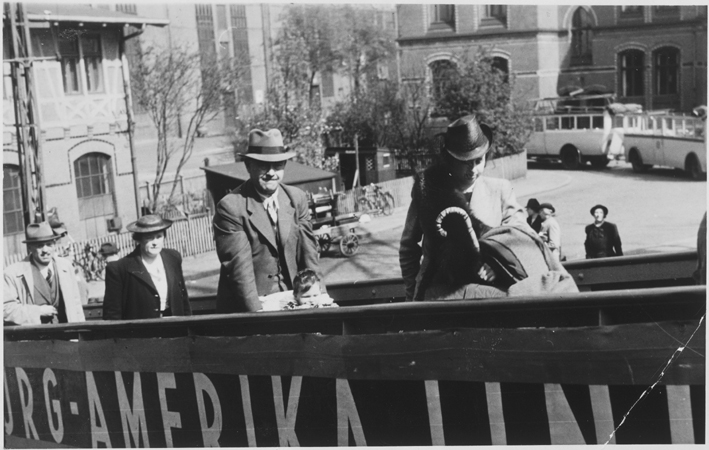
In early May 1939, the St. Louis set sail from Hamburg, Germany carrying slightly more than 900 Jewish passengers. Their destination was Havana, Cuba where they expected admission. The passengers held landing certificates which theoretically allowed entry into Cuba. Unfortunately, their expected immigration led to widespread protests in Havana, encouraging Cuba’s dictator Fulgencio Batista to cancel their entry permits. Eventually, only 28 passengers were permitted entry into Cuba. Subsequentially, the St. Louis left Havana and headed for Miami, Florida.
Sadly, FDR weighing his political options chose not to accept the Jews. Canada also denied Jewish immigration.
The decision was later summarized in the chilling phrase, “None is too many.” The comment was reputedly made by key immigration officials or Canadian Prime Minister, Mackenzie King. Canada had probably the most restrictive immigration policy of any Western democracy prior to World War II.
Longterm Ramifications of FDR’s Decision to Deny Entry of the Jewish refugees of the St. Louis.
Ultimately, Great Britain, the Netherlands, Belgium and France accepted the 900 refugees. Unfortunately, after Nazi Germany overran France, Belgium, and the Netherlands, they arrested many of these refugees. Some 25% died in the Holocaust.
FDR did decide to run for the presidency and successfully won a third term. He was able to negate the Neutrality Laws and provide vital military help to Great Britain from 1940-1945.
Hitler recognized that most nations were reluctant to allow entry of Jews into their country. As a result, when he conquered Eastern Europe with its millions of Jewish inhabitants, he decided to annihilate them realizing that their assimilation in Europe was tenuous.
After World War II, Jewish survivors chose not to return to their homelands in Eastern Europe. Instead, they preferred immigration into either the United States or Palestine. Denied formal entry into Palestine by British restrictions, many Jews secretly immigrated.
Conclusion
The St. Louis episode has since become a powerful case study in moral responsibility and the consequences of inaction. It illustrates how legal frameworks and political calculations can fail in the face of humanitarian crises. Governments at the time often justified their decisions by citing immigration laws, economic concerns, or fears of social unrest. Yet, viewed in hindsight, these justifications appear tragically insufficient given the scale of suffering involved.
I welcome your comments and constructive responses. Please email me at ernestwerlin@gmail.com.
