
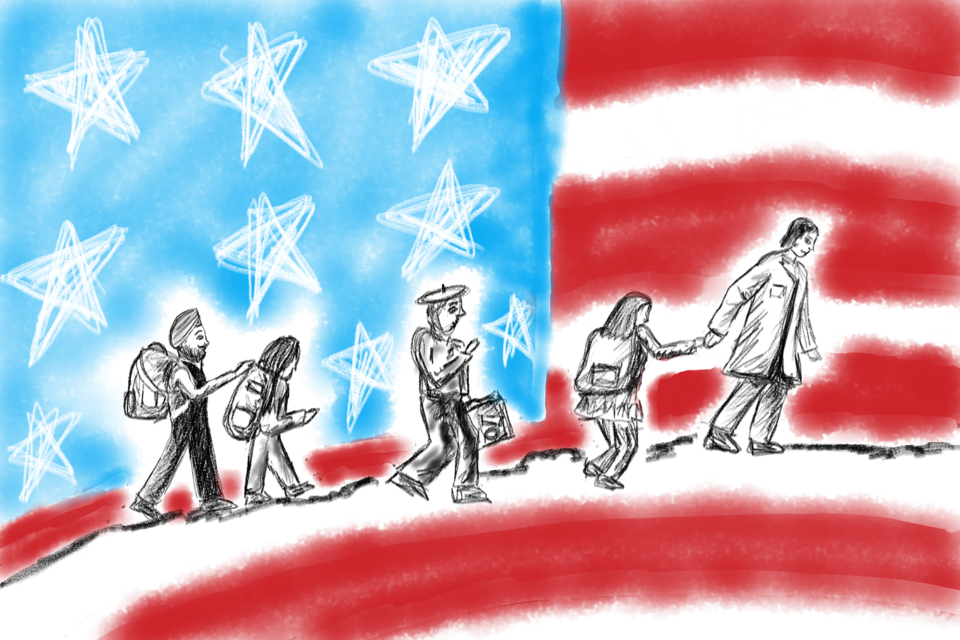
I recently saw an interview by Walter Isaacson with Tom Friedman. While they covered several topics, Friedman’s thoughts on immigration resonated with me.
Tom Friedman has long argued that immigration is neither a simple moral issue nor a purely security problem, but a complex systems challenge that sits at the intersection of economics, globalization, climate change, and governance. His position resists the ideological extremes of both “open borders” advocacy and restrictionist nationalism, instead emphasizing state capacity, rule of law, and strategic openness.
One phrase that Friedman used which highlighted his position is “America should build high walls between ourselves and Mexico, but these walls should house large gates.”
At the core of Friedman’s thinking is the idea that immigration works best when a country is strong, confident, and well-governed. He frequently argues that the United States should remain open to immigrants—especially skilled and motivated ones—but only if it maintains control over its borders and immigration systems. In Friedman’s view, compassion without order ultimately undermines public trust and fuels political backlash, which can lead to harsher and less humane policies over time. Stated differently, Friedman opposes the restrictions on would-be immigrants who have been accepted to our universities and professionals—policies initiated under President Trump. On the other hand, he opposed the open border policy of President Biden who advocated open borders without restrictions. Trump’s policies appealed to Nativists, while Biden’s policies alienated people who witnessed first-hand the overwhelming of our medical services, educational institutions, etc.
Economically, Friedman sees immigration as a net positive when properly managed. He often highlights America’s historical success in attracting ambitious people from around the world, arguing that immigrants contribute disproportionately to entrepreneurship, innovation, and economic growth. For example, in Sarasota, a high proportion of restaurants are owned and run by immigrants. Almost all the laborers in construction and golf course attendants are immigrants. In a globalized economy driven by knowledge, talent is a critical resource, and Friedman believes the U.S. weakens itself when it fails to attract and integrate it. Just think of the number of major tech companies headed by immigrants from India. At the same time, he warns that poorly regulated immigration can strain local services, depress wages at the lower end of the labor market, and erode political support for globalization more broadly. The appeal of Trump over Harris reflected dissatisfaction with Biden’s immigration policy.
A distinctive element of Friedman’s immigration stance is his emphasis on root causes. He consistently argues that mass migration cannot be understood in isolation from climate change, failed states, demographic pressures, and economic inequality. In his writing, immigration is often described as a “pressure release valve” for societies destabilized by drought, corruption, violence, or lack of opportunity. As climate change accelerates, Friedman predicts that migration pressures will intensify, making border enforcement alone an inadequate response. All one has to do is look at the millions of people fleeing Africa and Latin America because of civil wars, food challenges, drugs, etc. to comprehend the appeal of America and Europe.
Politically, Friedman is critical of both parties. He condemns nativist rhetoric that demonizes immigrants and ignores America’s immigrant heritage, but he is equally frustrated with what he sees as liberal naïveté—the belief that moral intent can substitute for functional policy. He argues that progressives must take border control seriously if they want to preserve public support for immigration and diversity. In this sense, Friedman treats immigration as a legitimacy problem: when citizens believe the system is out of control, they lose faith in democratic institutions.
Ultimately, Friedman’s position can be summarized as “high walls with wide doors”—a system that is firm, lawful, and technologically competent at the border, while being generous, efficient, and welcoming to legal immigrants and refugees. He believes the future of liberal democracy depends on proving that open societies can be both humane and orderly. Without that balance, he warns, immigration will continue to fuel polarization and empower authoritarian politics.
The polarized attitude toward U.S. Custom and Immigration Enforcement (ICE) reflects these differences. Many Americans are incensed by Sanctuary Cities that welcome undocumented immigrants. They point out that these immigrants weigh down the community—taxing the police authority, educational system, healthcare institutions, and housing facilities. On the other hand, Americans are distrustful of thousands of ICE agents wearing masks, forcibly attacking both illegal immigrants and even U.S. citizens, failing to recognize restrictions required by habeas corpus, and providing counter factual comments following killing of protesting U.S. citizens.
In Friedman’s view, immigration is not just about who crosses borders, but about whether democracies can still govern effectively in a rapidly changing world. Friedman criticizes President Trump for sabotaging bi-partisan efforts by Senators to update our immigration laws.
