
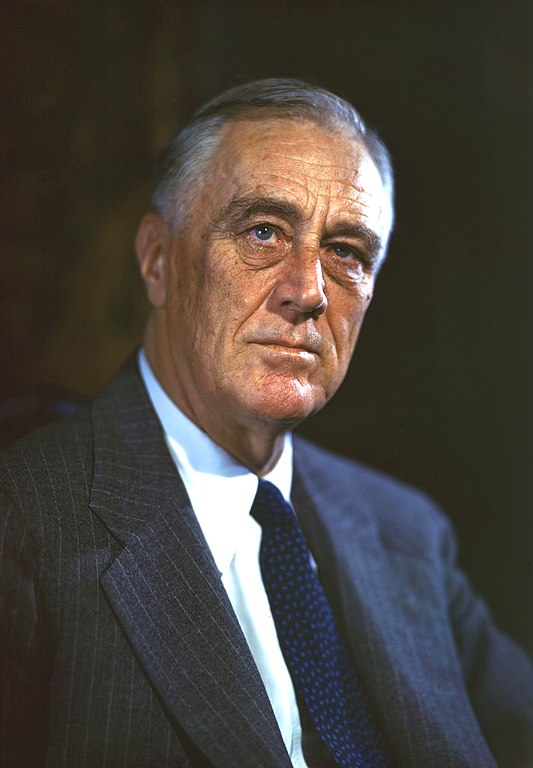
INTRODUCTION
If I were an excellent cartoonist like my friend, Mel Gerstein, I would draw a cartoon of Franklin Roosevelt, with a cigarette holder clenched in his mouth holding up the world like the mythical Greek hero Atlas. Winston Churchill, smoking a cigar, and Joseph Stalin, smoking a pipe would be grabbing his legs so that they would not fall into the abyss. Alas, I do not have Mel’s skills, and thus must convey my impression of the positive role played by Franklin Roosevelt in words. Maybe, when I return to Fort Lee, New Jersey in May, I can cajole Mel into drawing this cartoon as a preface to my essay.
KEY FOREIGN EVENTS LEADING TO AMERICAN ENTRY INTO WORLD WAR II
Year
Event
1931
Japan Invades Manchuria
1933
Hitler Becomes Chancellor of Germany
1933
Franklin Roosevelt Begins First Term as President
1934
Hitler orders Build up of submarines, tanks, air force
1936
Hitler Puts Troops into Rhineland
1937
Neutrality Act: Mandatory Ban of arm shipments to any Combatant
1937
Roosevelt Quarantine Speech. Proposed U.S. quarantine warmongering nations as a menace to public health.
1938
Hitler forces unification of Austria and Germany
1938
Hitler occupies Sudetenland in Czechoslovakia
1939
Hitler-Stalin Non-Aggression Pact
1939
Hitler invades Poland, staring World War II
1939
Roosevelt sought ways to assist Britain and France militarily.
1939
Roosevelt begins unusual correspondence with Churchill after later appointed Head of Admiralty
1940
Three Power Pact: Japan, Italy, Germany
1940
Churchill Elected Prime Minister of Great Britain
1940
Germany occupies France, Belgium, Norway, Holland
1940
Roosevelt appoints two key Republican interventionists to cabinet: Henry Stimson, Secretary of War and Frank Knox Secretary of Navy
1940
Roosevelt urges America become Arsenal of Democracy
1940
Destroyers for Bases Agreement: Give 50 American destroyers to Britain in exchange for base rights in British Caribbean islands
1940
Roosevelt reelected for unprecedented third term
1941
Congress Passes first peacetime draft by one vote
1941
Lend-Lease Act: Allow U.S. to give Britain, Russia, China and others $50 Billion of military supplies. No repayment after the war
1941
Roosevelt and Churchill Meet and develop Atlantic Charter. Roosevelt committed to “all aid short of war.”
1941
Roosevelt orders Stimson to begin planning for total American military involvement.
1941
Japan Attacks Pearl Harbor
1941
America occupies Iceland
1941
America froze all Japanese assets in the United States, preventing Japan from buying all but low grade oil in order to deer a Japanese invasion of the Dutch East Indies (Indonesia).
1941
Germany Declares War on the United States
MY PERSONAL INTEREST IN WORLD WAR II
Since many people know my passionate interest in history, they understandably ask me what my favorite period in history is. Without hesitation, I respond that the events surrounding World War II remain a source of unrequited fascination. Moreover, despite overdosing on reading material on this era, I still learn little facts that I cherish immensely.
Let me share with you one example, yesterday I learned that Anthony Eden’s wife (Anthony Eden was Churchill’s long-time number one assistant and Foreign Secretary) was the daughter of Winston Churchill’s younger brother Jack. Thus, not only were Eden and Churchill political allies, but that had “blood ties.”
WHO WOULD I HAVE WANTED TO BE IN 1940?
I would have liked to be Harry Hopkins, Roosevelt’s trusted friend. Hopkins whose unlikely encampment in the White House for many years became the inspiration for the play The Man Who Came to Dinner was Roosevelt’s eyes and ears in foreign affairs.
DO NOT URGE ME TO LEAVE YOU OR TO TURN YOUR BACK AND NOT FOLLOW YOU
FOR WHEREEVER YOU GO, I WILL GO; WHEREVER YOU LODGE I WILL LODGE
YOUR PEOPLE SHALL BE MY PEOPLE AND YOUR GOD WILL BE MY GOD
—–BOOK OF RUTH, CHAPTER 1
In 1940 at the height of the Battle of Britain, Harry Hopkins offered these comforting words to an anxious Prime Minister Winston Churchill in response to the latter’s question on what Hopkins would report back to President Franklin Roosevelt. Tears of happiness quickly filled Churchill’s eyes. These words by Hopkins gave solace to a desolate Churchill that his efforts to persuade the United States to provide material aide to Britain might break the logjam of the heretofore “tightfisted” Yankees.
Being a trusted aide of FDR and living in the White House meant that Hopkins twenty-four hours a day was on call. Although Hopkins was dying from stomach cancer, he willed himself to take arduous trips to both Great Britain and the Soviet Union to provide FDR with first hand knowledge of the personalities and will power of both Churchill and Stalin. Because FDR deeply distrusted his Ambassador to the Court of St. James, Joseph Kennedy, FDR sent Hopkins as his personal envoy to Great Britain to assess Churchill and the will of the British people to stand up alone against the massive Nazi war machine.
REMARKABLE PARTNERSHIP
“It is always best and safest to count on nothing from the Americans but words”—British Prime Minister Neville Chamberlain. Indeed, unlike the warm bonds between Churchill and Roosevelt, the relationship between Chamberlain and Roosevelt was “frothy.”
Civilization was saved by the leadership and friendship of two remarkable men, Winston Churchill and Franklin Roosevelt. The odds against these men forming a winning team against the Axis powers must have been more than one million to one. Each of them beat tremendous odds to reach the “top of a slippery pole.” Alternatively stated, only desperate circumstances provided them a chance to rule their respective nations.
“Without a lead on his part (Franklin Roosevelt) it was useless to expect the people would voluntarily take the initiative to letting him know whether or not they would follow him if he did take the lead.”
Henry Simpson, Secretary of War, April 22, 1941
“And while I am talking to you mothers and fathers, I give you one more assurance. I have said this before, but I shall say this again and again and again: Your boys are not going to be sent into any foreign war.”
Franklin Roosevelt, October 30, 1940
(Post Script: Roosevelt knew when he was giving this speech that he was “lying again, and again, and again.” However, this lie can easily be defended as a “white lie” given the extremity of calamitous power of the Nazis throughout Western Europe. Moreover, Roosevelt was in a very tight presidential election race against Wendell Wilkie and knew that a majority of the electorate preferred peace.)
“When you see a rattlesnake poised to strike, you do not wait until he has struck before you crush him. These Nazi submarines and raiders are the rattlesnakes of the Atlantic.
Franklin Roosevelt, September 1941
“We shall go on to the end, we shall fight in France, we shall fight on the seas and oceans, we shall fight with growing confidence and growing strength in the air, we shall defend our Island, whatever the cost may be, we shall fight on the beaches, we shall fight on the landing grounds, we shall fight in the fields and in the streets, we shall fight in the hills; we shall never surrender, and even if, which I do not for a moment believe, this Island or a large part of it were subjugated and starving, then our Empire beyond the seas, armed and guarded by the British Fleet, would carry on the struggle, until, in God’s good time, the New World, with all its power and might, steps forth to the rescue and the liberation of the old.”
—Winston Churchill, June 1940
(Churchill’s determination to “fight on” irrespective of the overwhelming advantage of the Nazis was the principle reason why Roosevelt overrode the objections of his military advisors to deploy needed armaments from the American army to Great Britain.)
BLACK SWAN IN POLITICS: LET ME ELABORATE
The likelihood of Franklin Roosevelt and Winston Churchill leading their countries during World War II was a likely as a “Black Swan.”
In the early 1920’s Franklin Roosevelt contracted polio and was virtually bed ridden for several years. During that era, most polio victims were literally locked in their rooms and kept out of sight. Through a combination of incredible will-power, the help of Louis Howe, a downtrodden but devoted former journalist, and his estranged wife, Eleanor, Roosevelt, Franklin Roosevelt resumed an active political life, ultimately becoming president in 1933 when America was suffering from a debilitating economic depression that threatened to bring down our capitalistic system. In fact, until 1938, Roosevelt had shown little inclination to demur from the prevalent isolationist and pacifist tendencies in the United States.
To win public office, Roosevelt needed to use legerdemain to hide the extent of his paralysis from the American electorate. After thousands of hours of painful trial and error, Roosevelt learned to create the façade of walking. Clenching hard on to arms of his assistants to prevent falling flat on his face, Roosevelt would amble up to a podium. In order to keep the audience focused on his upper body, Roosevelt would laugh and smile while making Herculean efforts to propel himself forward.
A VOICE IN THE WILDERNESS
Churchill’s selection as Prime Minister during the dark days of May 1940 capped also an unbelievable political come back. Churchill’s critics derided him as a “warmonger, schemer, opportunist, disloyal, drunkard, and irrational. Nevertheless, a combination of disgruntled Conservative “young Turks” and Labor Party Leaders brought Churchill out of his political wilderness to lead his beleaguered nation. In fact, a majority of his own Conservative Party preferred Lord Halifax to Churchill as a replacement for the disgraced Neville Chamberlain. Ironically, Churchill’s elevation was solely a function of the unwillingness of Labor Leaders to participate in a National Government Coalition led by Halifax. That is, they preferred the “blue blood” Churchill even though he had ruthlessly broken “The Great Strike of 1926” to Lord Halifax. Within weeks of Churchill’s elevation to Prime Minister, Churchill had to out negotiate Halifax over five days of heated discussion in the War Cabinet. Churchill not only won, but coaxed Halifax for the “sake of our love of country” to remain at his post of Foreign Secretary. Their argument was over Churchill’s outright rejection of “any negotiation with Hitler” to seek out “Hitler’s terms for an armistice with Great Britain.” Churchill understood that any discussion with Hitler would eliminate any hope for meaningful foreign aid from the United States, and thereby sending Britain down a “slippery slope.”
These unlikely bedfellows, Winston Churchill and Franklin Roosevelt, needed to form a strong political alliance in order to 1) maintain a formidable enough military presence to forestall further fascist global advances 2) outmaneuver the pacifists of their nations who preferred accommodation to Hitler.
Lastly, Roosevelt’s impression of Churchill was the later was a “stinker” given their unpleasant first meeting during World War I. In essence, Roosevelt needed to overcome a generation of distrust in order to take the gamble that diverting scarce American military arsenal to Great Britain was a worthwhile risk.
BIG PICTURE: SIGNIFICANT STEPS TAKEN BY ROOSEVELT
In regard to Roosevelt’s actions during the fateful period, 1940-1941, Roosevelt was indeed “The Lion and the Fox.” He chartered the perfect strategy of providing “all aid to Britain short of war”; that is, navigating the difficult, extremely cautious path between neutrality and belligerency. Fortunately, in this case, many of his devious means had a legitimate end. That is, because of America’s providing a tremendous arsenal of weapons first to Great Britain and then to the Soviet Union, our “undeclared naval war against Nazi Germany, our employment of an embargo that prevented essential materials being delivered to Japan, America ultimately became embroiled in World War II. Each step taken by Roosevelt required adroit maneuvering to outwit his pacifist Congressional opponents: 1) Trading 50 World War I destroyers for the right to use British naval basis in the Caribbean for an extended period 2) Lend Lease 3) Occupation of Iceland 4) Undeclared “naval war against Nazi Germany 5) Providing naval escorts to assure Britain received needed food and supplies 6) Imposing an Embargo in Japan for their occupation of territories such as Vietnam, and Indonesia and their continued military presence in China.
ROOSEVELT’S POLITICAL LIMITATIONS
Many forms of Government have been tried, and will be tried in this world of sin and woe. No one pretends that democracy is perfect or all-wise. Indeed, it has been said that democracy is the worst form of Government except all those others that have been tried from time to time.
—-Winston Churchill
Unlike Stalin or Hitler, Roosevelt had limited power to initiate quick changes in policy. In the beginning of 1940, Franklin Roosevelt needed to reverse two entrenched dogmas: 1) isolationism and 2) pacifism. Specifically, Americans disillusioned by the utter failure of our sacrifices to “Make the World Safe for Democracy” were totally disillusioned with foreign ventures, especially outside our hemisphere. Secondly, although “on paper America possessed foremost industrial strength” her army was a lightweight, ranking in size about fortieth in the world. Our small peacetime army had pacifist roots. That is, as an antidote to the wasteful warfare and spending on armaments by European nations, Americans as far back as our founding fathers had disdained a large standing army in peacetime. Given the fiscal restraints of the depression, American citizenry were unwilling to pay for a major military build-up, and the enactment of a peacetime draft.
In essence, despite the ominous takeover or threatened takeover of large parts of the globe by fascist Germany, Japan, and Italy, many Americans believed that the Atlantic and Pacific Ocean were permanent fortresses against these hostile dictatorships.
Roosevelt who had a masterful detailed knowledge of world politics pondered over each jerky step required to stop what seemed like the invincible tide of dictatorships. That is, in order to obtain his objectives, Roosevelt needed the stealth of a fox not the strength of a lion to 1) help our erstwhile allies 2) build-up our war machine and 3) change public opinion and 4) break first the spirit and then the letter of the 1935 Neutrality Act which provided a strict arms embargo on the provision of armaments to all belligerents in a war ‘between, or among two or more foreign states, irrespective of American sympathies.
COULD FDR BE TRUSTED?
We must never forget that Roosevelt carefully kept his true feelings hidden even from his closest advisors. He would cultivate views from discordant sources before forming his own policy decisions. Sometimes he acted quickly, sometimes he acted only after months of sowing bitter discord among his aides and sometimes policies just evolved by happenstance.
Let me share with you this one true anecdote that conveys the duplicity of FDR.
Henry Morgenthau Jr. was a very close, social, personal friend of Roosevelt. He had even been an early political supporter of Franklin Roosevelt when most of Roosevelt’s neighbors wrote him off as a “Momma’s boy.”
Morgenthau was the Secretary of the Treasury for Roosevelt from 1933-1945. Nevertheless, he never bought a home in Washington DC because he had absolutely no confidence that his relationship with FDR was durable. That is, he had seen Roosevelt turn on old friends and abandon them in the spur of a moment.
ARSENAL OF DEMOCRACY AND COMMUNISM
Moreover, without our meaningful support both of men and arms to our wartime allies, Great Britain and the Soviet Union, civilization was spared from the “recurrence of the dark ages.”
“ What General Weygand called the Battle of France is over. I expect that the battle of Britain is about to begin. Upon this battle depends the survival of Christian civilization. Upon it depends our own British life, and the long continuity of our institutions and our Empire. The whole fury and might of the enemy must very soon be turned on us. Hitler knows that he will have to break us in this island or lose the war. If we can stand up to him, all Europe may be free and the life of the world may more forward into broad, sunlit uplands. But if we fail, then the whole world, including the United States, including all that we have known and cared for, will sink into the abyss of a new Dark Age made more sinister, and perhaps more protracted, by the lights of perverted science. Let us therefore brace ourselves to our duties, and so bear ourselves that if the British Empire and its Commonwealth last for a thousand years, men will still say, ‘This was their Finest Hour.”
—-Winston Churchill May 1940
—-
MR. MACHIAVELLI COMES TO WASHINGTON DC. ALTERNATIVELY, FRANKLIN ROOSEVELT COULD OPERATE IN THE SHADOWS, BUT WAS CONSTRAINED BY OUR DEMOCRATIC FORM OF GOVERNMENT
To be succinct, Roosevelt used all methods at his disposal—wheeling dealing, deception, masterful propaganda, deploying first class rhetorical skills, and wielding consummate political statesmanship to alter the isolationist sentiment in the United States, and begin meaningful rearmament. Nevertheless, “that Man in the White House” could only safely stay one step ahead of public opinion polls to make meaningful executive decisions. Stated differently, if Roosevelt would have made a misstep or articulated openly his pro-British policies, he certainly would not have been nominated for a third term in the summer of 1940. Thus, America could have taken drastically different policy decisions, particularly if an isolationist such as Robert Taft would have become President.
1940 PRIORITIES OF THE AVERAGE AMERICAN
We must remember that in 1940, Americans were still suffering from a very severe recession, viewed two term Presidential limits as sacrosanct, wanted to avoid becoming embroiled in a war against either Germany or Japan, and felt that the number one priority was rebuilding our own military capacity rather than share of meager resources with either Great Britain or the Soviet Union. From the average American to key congressional legislators believed that America had been inveigled into involvement in World War II by foreign financiers, bankers and arms manufacturers who stood to profit from an Allied victory.
POLITICAL INSTABILITY IN BOTH GREAT BRITAIN AND THE SOVIET UNION
GREAT BRITAIN
For different reasons, both Winston Churchill and Joseph Stalin were on a slippery slope fighting against Nazi Germany. Thus, without meaningful American support, either Great Britain or the Soviet Union or both of them could have thrown in the towel of surrender to Nazi Germany. In fact, many leading politicians or political observers believed that Winston Churchill would be prime minister for a short time. Our Ambassador to the Court of St. James, Joseph Kennedy, so heartily disliked and distrusted Churchill that he fabricated malicious rumors to undermine Churchill’s leadership. Churchill’s likely replacement, Lord Halifax, would make peace overtures to Hitler in order to save as much of the British navy and Empire as possible given that Hitler distinctly held the upper hand.
SOVIET UNION
While Stalin clearly closely held all the strings of power within the Soviet Union, his demonic leadership had alienated many of his subjects, including major non-Russian ethnic groups such as Ukrainians, White Russians, Volga Germans, non- communists and devout Greek Orthodox adherents. In essence, in 1940 communist control of the Soviet Union was based on brutal employment of police state apparatus that favored its Russian ethnic population at the expense of hundreds of disparate subjugated ethnic minorities. Given the unpopularity of Stalin, most Soviet citizens longed for a regime change.
In essence, given the colossal drubbing of Soviet troops, mostly due to Stalin’s inept decisions, many restive Soviet citizens who were psychologically disgusted with their ruthless Communist overlords were ambivalent about making the major sacrifices required to defeat Nazi Germany. To summarize, only three out of 100 military personnel survived physically in tact World War II. Close to twenty-five million Soviet civilians died during World War II, and some twenty thousand towns and villages were annihilated. Therefore, keeping the fighting morale of the Red Army vigilant against the Nazis required unmitigated police state brutality against any wayward person at all levels of the Soviet society throughout its huge borders. The inference of any sign of complicity or resignation would subjugate the defendant to capital punishment or incarceration in Siberia.
On the other hand, Stalin’s attitude toward being enmeshed in a “fight to the death” war with Germany was ambivalent even after the massive German surprise attack on June 21, 1941. While the evidence is somewhat sketchy, there exists evidence that Stalin was willing to make major concessions to Germany in 1941 and 1942 to achieve at least a temporary armistice. Stalin bitterly knew that many Englishmen relished the blood letting by the Nazis and Communists.
