
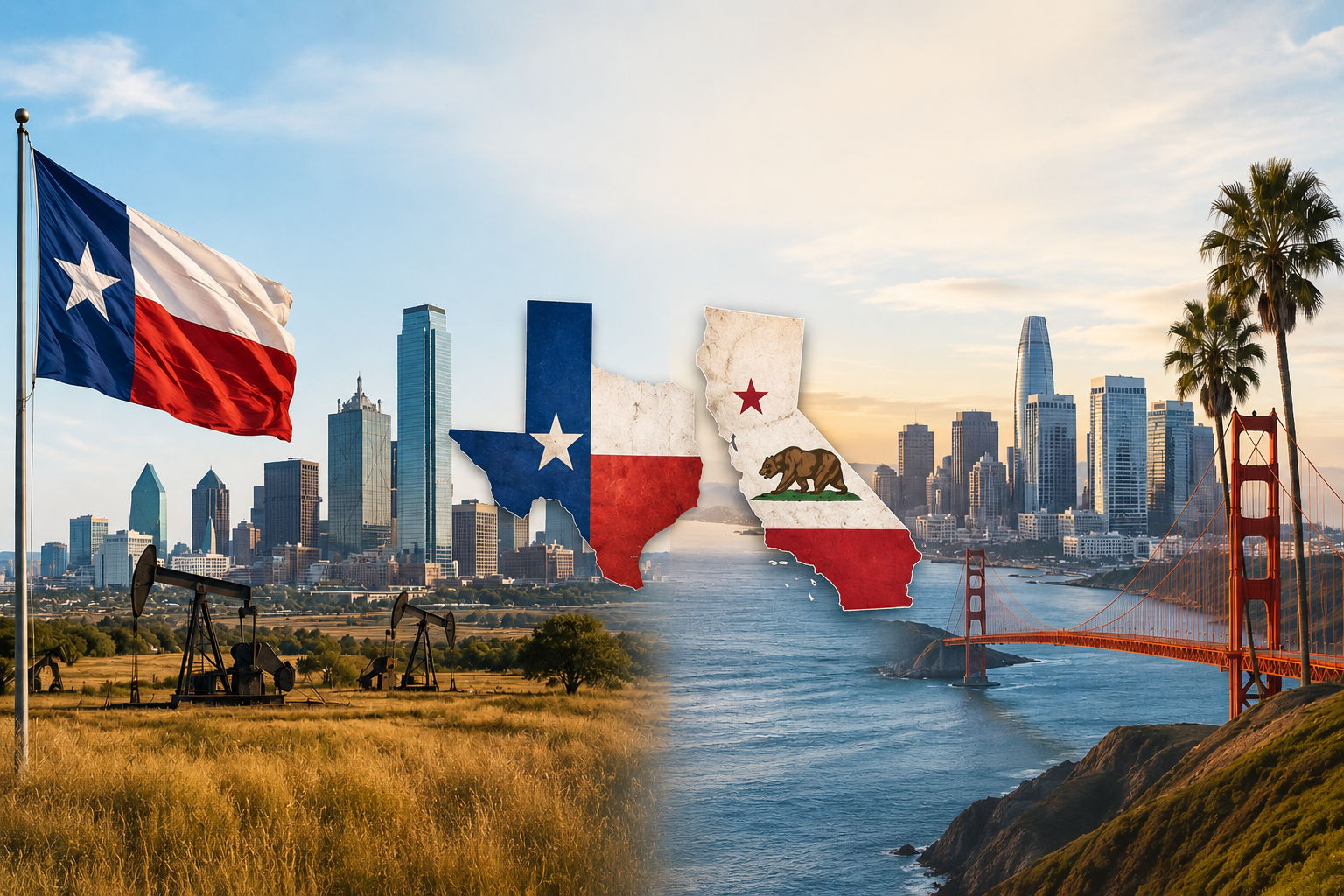
The United States enjoys the remarkable advantage of having two states—Texas and California—that could each stand alone as prosperous and influential nations. If treated as independent countries, California would possess the world’s fourth-largest economy, while Texas would rank approximately eighth.
| Economy | Population | |
| California | $4.1 trillion | 39 million |
| Texas | $3.0 trillion | 31 million |
California’s economy generates approximately $105,000 per person compared to about $97,000 in Texas. California’s economy is roughly comparable in size to Germany or Japan, while Texas compares to countries such as Canada or Italy.
Although California remains the larger economy, the most important story is growth. Over the past decade, Texas has generally grown faster, gained population, and attracted numerous corporate relocations. California continues to lead in technology and innovation, while Texas increasingly dominates in business expansion, energy, and population growth. As a native Texan, I often describe Texas as a “Can Do Nation” filled with entrepreneurs and opportunity seekers.
California has long been regarded as America’s economic powerhouse. With an economy exceeding $4 trillion, it is home to Silicon Valley, the global center of technological innovation. Companies such as Apple, Google, Meta, and Nvidia have created enormous wealth and transformed the world economy. California also dominates the entertainment industry through Hollywood and remains a leading agricultural producer despite its highly urbanized population.
Texas, however, has emerged as a formidable competitor. Its economy now exceeds $3 trillion and continues to expand rapidly. Houston serves as the energy capital of the world, while Dallas, Austin, and San Antonio have become important centers for finance, technology, healthcare, and manufacturing. In recent years, Texas has attracted major investments from Tesla, Oracle, Samsung, and Hewlett Packard Enterprise. Dell Technologies, founded by Michael Dell in Austin, remains one of the state’s greatest entrepreneurial success stories.
One of the most significant differences between the two states is taxation. California imposes a progressive state income tax with some of the highest rates in the nation. Supporters argue that these revenues fund education, infrastructure, environmental protection, and social services. Critics contend that high taxes discourage investment and encourage wealthy individuals and businesses to relocate. In recent years, many high-income taxpayers have moved from California to states such as Texas, Florida, Nevada, and Arizona.
Texas takes a different approach. The state imposes no personal income tax, making it attractive to entrepreneurs, executives, and skilled workers. Supporters argue that lower taxes encourage business formation and investment. Critics note that Texas relies more heavily on property and sales taxes. In many ways, the tax debate reflects broader political differences: California is generally a blue state, while Texas is generally a red state.
Regulation represents another major contrast. California is known for extensive environmental, labor, and consumer protection regulations. These policies have helped produce cleaner air, workplace protections, and environmental leadership. California has often been at the forefront of efforts to address climate change and promote renewable energy.
Texas generally favors a lighter regulatory approach. State leaders emphasize reducing business costs and streamlining permitting processes. Supporters argue that this encourages investment and economic growth. Critics contend that less regulation may sometimes come at the expense of environmental protection or worker safeguards.
Both models have advantages and disadvantages, depending upon one’s priorities.
Population trends have increasingly favored Texas. Over the past decade, Texas has experienced strong population growth as individuals and businesses moved to the state seeking economic opportunity and lower living costs. Cities such as Austin, Dallas, Houston, and San Antonio have expanded rapidly. California continues to attract talented workers from around the world, but its population growth has slowed due in part to high housing costs and living expenses.
Some projections suggest that after the 2030 Census, Texas could gain four seats in the House of Representatives while California could lose four. These trends reflect the migration of residents from California to states such as Texas, Florida, Nevada, and Arizona.
The growth of Houston illustrates Texas’s broader success. When I was born in Houston in 1944, the metropolitan area had approximately 528,000 residents. Today, Greater Houston is home to nearly 8 million people. Few metropolitan areas in America have experienced such sustained growth.
Housing affordability represents one of the clearest differences between the two states. In many parts of California, home prices have risen dramatically, making homeownership difficult for middle-class families. Restrictive zoning regulations, geographic constraints, and strong demand have all contributed to high costs.
Texas generally maintains a more affordable housing market. Although housing prices have risen significantly in recent years, the state continues to build new homes at a much faster pace than California. Houston, which famously lacks traditional zoning, frequently issues more housing permits than the entire state of California. Lower housing costs remain one of Texas’s strongest competitive advantages.
Energy policy offers another interesting comparison. Texas is the nation’s leading producer of oil and natural gas while also leading the nation in wind energy production and rapidly expanding solar generation. California has pursued an aggressive transition toward renewable energy and electric vehicles. While California has become a global leader in environmental policy, Texas emphasizes a balanced approach that includes both traditional and renewable energy sources.
The labor markets of both states are highly dynamic. California benefits from world-class educational institutions such as Stanford, Berkeley, UCLA, and Caltech. Texas boasts outstanding universities as well, including the University of Texas, Texas A&M, Rice University, and the University of Houston. Both states attract talented workers, although Texas’s lower cost of living has become an increasingly important advantage.
Despite their differences, Texas and California share many similarities. Both benefit from large populations, entrepreneurial cultures, diverse industries, and strong connections to global markets. Both are leaders in technology and innovation. Both attract substantial domestic and international investment.
The future economic competition between these states will depend upon how they address key challenges. California must confront housing affordability, infrastructure demands, and business competitiveness. Texas must continue investing in education, transportation, water resources, and electrical infrastructure to support its rapid growth.
In conclusion, Texas and California represent two highly successful but distinct economic models. California excels in innovation, technology, education, and environmental leadership. Texas offers a business-friendly climate, lower taxes, affordable housing, and strong population growth. Neither model is perfect, and each face significant challenges. Yet together, they demonstrate the remarkable diversity and dynamism of the American economy.
If current trends continue, I believe Texas could eventually surpass California in population. No state income tax, lower housing costs, strong job growth, corporate relocations, and abundant land for development provide Texas with powerful long-term advantages. Whether or not Texas ultimately becomes the most populous state, it has clearly established itself as one of the world’s most dynamic economic success stories.
