
The Wall Street Journal recently observed that the United States is drifting toward a new economic model—what it describes as state capitalism. This system is neither socialism, in which the government owns the means of production, nor traditional free-market capitalism. Instead, it is a hybrid in which private ownership formally remains intact, but the government increasingly uses tariffs, regulation, equity stakes, revenue sharing, and political leverage to steer corporate behavior.
Versions of state capitalism are not new. Japan and Western Europe experimented with it in the postwar period. It remains central to the economic systems of China and Russia today. But for the United States, this represents a sharp break from a long-standing tradition of relying on free enterprise. A more candid term for state capitalism might be crony capitalism—or, uncomfortably, a version of fascist economic policy.
Outside of wartime, the U.S. has historically avoided deep government involvement in business decisions. During the Civil War and the two World Wars, Washington intervened heavily to mobilize production. Once peace returned, it stepped back, allowing markets to allocate capital and determine winners and losers. That restraint was not accidental; it was foundational and fundamental for American prosperity.
Today, policies that once would have been unthinkable in peacetime have become routine.
The danger is not merely economic inefficiency, but resemblance to systems with troubling historical precedents. Fascist economic policy did not abolish private property. Instead, it subordinated markets to national goals through corporatist arrangements in which the state, business, and labor were tightly integrated. Governments dictated production priorities, controlled trade, suppressed competition, and rewarded political loyalty over innovation. Free trade gave way to autarky. Success depended on access to power, not consumer choice.
History is unambiguous about the results. Argentina under Juan Perón, Germany under Hitler, Italy under Mussolini, and Spain under Franco all pursued variants of this model. None produced durable prosperity. Argentina still struggles with inflation and capital flight. Spain stagnated for decades. Germany and Italy devoted vast resources to state-directed industrial and military expansion, with the catastrophic consequences of World War II.
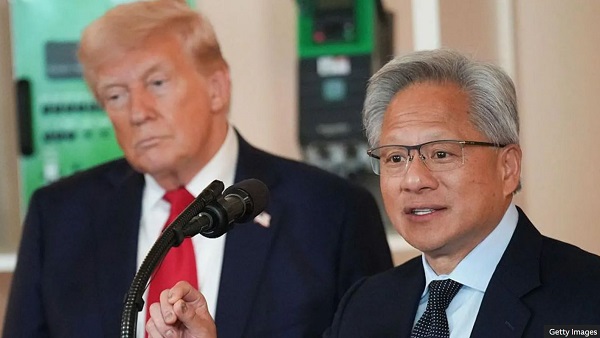
A recent example highlighted by the Journal illustrates how far the U.S. has drifted. Nvidia was granted permission to sell advanced semiconductor chips to China—on the condition that the federal government receive 25% of the revenue. In effect, Nvidia paid for a license that had previously been free: the right to sell its own products abroad. The company did not object. CEO Jensen Huang remarked that “whatever it takes” to gain approval was acceptable.
This raises a basic question: Why was it illegal for Nvidia to sell these chips before the government claimed a quarter of the revenue—and legal afterward? The answer has less to do with national security than leverage.
The deal reveals the evolving relationship between business and government under the Trump administration. The president has routinely intervened in corporate affairs—taking equity stakes, demanding revenue shares, pressuring firms on prices, steering mergers, and directing sales through federal platforms. The state does not own companies, but it increasingly shapes outcomes.
This is a two-way arrangement. Companies that align with the administration’s priorities are rewarded with tariff relief, regulatory leniency, merger approvals, and access to restricted markets. State capitalism, in practice, serves not only the interests of the state but also those of favored firms.
Whether this benefits the country is another matter. Focusing on revenue sharing obscures the real issue: strategic risk. Are we undermining U.S. security by enabling the transfer of advanced technology to our principal rival? Would Americans have accepted U.S. companies selling steel or oil to Nazi Germany in exchange for a government cut of the profits? Monetizing risk does not eliminate it.
The same logic underpins the administration’s broader industrial policy. Tariffs and subsidies are aimed at reviving steel, autos, and aluminum—industries that dominated the economy in the mid-20th century. But the world has changed. U.S. labor costs cannot compete with those of China, Mexico, or Southeast Asia. Trying to resurrect 1950s industrial dominance ignores globalization and comparative advantage.
America’s real strengths lie elsewhere: semiconductors, artificial intelligence, advanced technology, pharmaceuticals. Yet even here, government intervention distorts incentives. Rather than encouraging competition and creative destruction, the state increasingly picks winners, protects incumbents, and penalizes firms that fall out of political favor.
Economic history warns government interference rewards toadies and not entrepreneurs bent on creative destruction. Adam Smith understood in 1776 that decentralized markets outperform systems directed from above. Milton Friedman spent the 20th century demonstrating that free markets—not government planning—produce sustained growth.
Europe provides a modern example. Since 2000, Europe’s economy has grown at roughly 40% of the U.S. rate. Heavy regulation, high taxes, and rigid labor rules discourage entrepreneurship. In 2000, Europe had four of the ten largest companies by market value. Today, it has none. Its largest firm is worth about $400 billion—less than one-tenth the value of Nvidia. The U.S enjoys 9 out of the 10 largest companies. Bottom line—we have mediocre politicians and great business leaders!
Yet Washington continues to deepen its involvement. Pfizer agreed to lower drug prices, sell through a federal portal, and invest domestically in exchange for tariff relief. When Pfizer later competed with Denmark’s Novo Nordisk for an obesity drug startup, regulatory scrutiny tilted the outcome. Staying in the administration’s good graces mattered. Of course, the European Union will retaliate when American firms want to buy companies in their sphere of influence. Tic for Tac is as old as the Bible!
Nowhere is the alignment between state and capital more visible than in artificial intelligence. Tech leaders and the Trump administration agree that AI dominance is critical to economic and strategic power. Silicon Valley supported Trump early and was rewarded with deregulation, tariff exemptions, and a $500 billion AI infrastructure initiative.
The government has gone further, becoming a participant. After Trump demanded a 10% equity stake in Intel, Nvidia invested in the company—despite Intel being a supplier and competitor. These circular investments blur the lines between rivals, customers, and the state. As former antitrust official Doha Mekki noted, such arrangements begin to look “trust-like.”
The conclusion is unavoidable. The United States is abandoning the principles that made it the world’s most successful economy. We prospered by letting firms compete, succeed, and fail without government rescue. Propping up declining industries will not restore their dominance. Favoring domestic firms invites retaliation. And government officials—however well intentioned—are not well equipped to decide which companies or technologies will define the AI future.
