
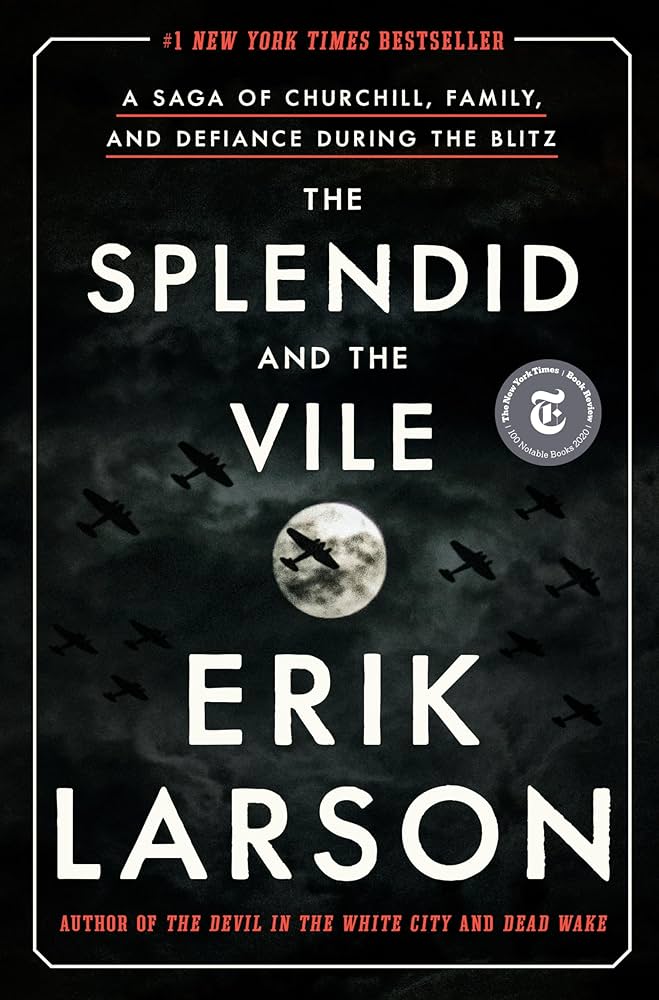
The Splendid and The Vile
By Erik Larson
I recently finished the book, The Splendid and the Vile by Erik Larson. Larson focuses on the first year of Winston Chuchill’s ascendency to become Prime Minister of Great Britain in May 1940.
Erik Larson chose the phrase, “The Splendid and the Vile” as the title because it perfectly captures the paradoxical duality of life in Britain during Winston Churchill’s first year as prime minister—a time that was simultaneously inspiring (“splendid”) and horrifying (“vile”). The title reflects the emotional and historical contrasts that defined the period between 1940 and 1941, especially during The Blitz.
Civilization needs to be eternally grateful that both Britain and the United States enjoyed two remarkable leaders—Winston Churchill and Franklin Roosevelt—contemporaneously. Their shared concerns about the ascendency of Nazi Germany under Adolph Hitler were a godsend. Moreover, the two men enjoyed a personal chemistry that fortified the alliance.
While it is well known that Churchill used all of his literary and rhetorical skills to woo President Roosevelt, it is not fully comprehended that Roosevelt took unprecedented steps to communicate with Churchill. That is, as soon as Churchill became First Lord of the Admiralty in May 1940, FDR took the unprecedented step of communicating directly with Churchill. Roosevelt believed, which was later confirmed, that only Churchill could lead Great Britan during this wartime crisis. In doing so, Roosevelt ignored the negative comments by Joseph Kennedy who (1) disliked and belittled Churchill, and (2) favored appeasement.
Using diaries, letters, government documents, and the private communications of Churchill’s family and inner circle, Larson constructs an intimate portrait not only of wartime leadership but also of the emotional, psychological, and social worlds in which ordinary Britons and Britain’s political class lived. The book’s title, juxtaposing “splendid” and “vile,” encapsulates the paradoxes of life under bombardment—fear and courage, suffering and resilience, tedium and terror—as well as the complexity of Churchill himself. Ultimately, Larson offers a compelling examination of how leadership, narrative, and character can sustain a nation during existential crisis.
The Blitz has been widely documented, yet Larson revives it through close attention to individuals: Churchill’s private secretary John Colville, his daughter Mary, his scientific advisers, RAF pilots, German officials, and even everyday Londoners. This multi-perspective approach enriches the narrative, allowing readers to experience the war not as a series of distant strategic moves but as a lived daily reality.
At the center of the narrative stands Winston Churchill, portrayed neither as flawless hero nor as caricature but as a man of unusual energy, rhetorical genius, and strategic clarity.
Specifically, Churchill understood that (1) in the long run, Britain, its Empire, the Dominions and America had much greater resources than Germany and Italy (2) To survive he needed material supplies and food from the United States, and (3) To attain victory he needed America to abandon neutrality and become a belligerent.
To accomplish these goals, Churchill had to overcome the negative impression left by the former Ambassador to the Court of St. James, Joseph Kennedy, who wrongly claimed that the British people lacked the will to carry on after the fall of France and that Churchill was a mediocre drunk who could not effectively lead Great Britain during this tumultuous time.
Larson depicts Churchill as a leader who understood that victory required not only military planning but emotional persuasion. His speeches— “We shall fight on the beaches,” “Their finest hour,” “Never in the field of human conflict…”—served as powerful psychological tools that shaped national morale. Larson underscores Churchill’s gift for transforming fear into resolve and doubt into defiance.
Churchill emerges as a man whose personal quirks—working from bed, holding meetings in his bath, staying up late dictating memos—coexist with profound strategic insight and moral conviction.
Larson also highlights the fragility of Britain’s position in 1940–41. Far from being inevitable, British survival was precarious. The Luftwaffe’s relentless bombings were intended to break civilian morale and force Britain into negotiation. Churchill’s refusal to consider peace terms was, therefore, both politically risky and profoundly consequential. The book meticulously reconstructs the German perspective, including Hitler’s hope that Britain would eventually sue for peace and Göring’s failure to deliver on promises to devastate British air power. This juxtaposition humanizes both sides without equating them, illustrating how miscalculations, personal rivalries, and shifting strategies shaped the war’s early trajectory.
Another important theme is resilience—the capacity of individuals and communities to endure prolonged hardship. Larson shows how Londoners adapted to nightly bombings by creating routines: retreating to shelters, socializing underground, checking on neighbors, repairing homes, and returning to work each morning. This social resilience mirrored the psychological resilience modeled by Churchill. His presence in bombed-out neighborhoods, his insistence on walking the streets despite danger, and his visibility as a wartime leader helped transform collective suffering into shared purpose.
Within a few months, the skeptical King George V, who initially favored Lord Halifax to succeed Neville Chamberlain, recognized that Churchill was absolutely the right man for this precarious time in British history. King George V also was the right titular leader. From sharing the nutritional challenges of the average Englishmen to his visits to bombed out communities, the King was the perfect model of a monarch.
Larson argues implicitly that leadership during crisis involves not only decision-making but symbolic action: the ability to represent national character and aspirations.
Larson’s fusion of storytelling and scholarship makes The Splendid and the Vile both highly engaging and intellectually substantive. It invites readers to inhabit a tumultuous historical moment while illuminating the structural forces—political, military, psychological—that shaped it.
In conclusion, The Splendid and the Vile is more than a chronicle of Churchill’s first year as prime minister. It is a study of how leadership, narrative, and human resilience intersect in moments of crisis. Through personal stories and meticulous research, Larson shows how the British people confronted the terror of The Blitz, how Churchill crafted a vocabulary of courage that sustained a nation, and how the tension between ordinary life and extraordinary danger produced a period both splendid and vile. The book reminds modern readers that history is not only made by armies and governments but by individuals who, even amid catastrophe, find ways to hope, adapt, and endure.
